
While gender inequalities in mathematics appear as early as primary school, an impact study conducted on over 500 students reveals a groundbreaking finding: while all students progress with our Adaptiv’Math+ module, girls, in particular, advance up to four times faster than boys. These results, unveiled on June 17th in Paris at a press conference bringing together researchers, teachers, and AI experts, confirm the major role that artificial intelligence can play in building a more equitable education system.
A rigorous study, a matter of equality
On Tuesday, June 17th, we presented the results of our impact study conducted with two public research laboratories: the LaPsyDé laboratory (Université Paris Cité) and the Flowers laboratory (Inria Bordeaux).
The experiment, involving 555 students in the third cycle of primary school, aimed to measure the effect of the Adaptiv’Math+ adaptive learning module on mathematical skills. The conclusions of this study, presented in Hong Kong at the Mathematical Cognition and Learning Society (MCLS 2025) international conference from June 9-11, 2025, are unequivocal: students using our solution progress up to twice as fast as their peers. But above all, girls benefit dramatically , allowing them to partially close the gap with boys—a crucial issue in a context where gender inequalities begin in primary school and continue to widen thereafter.
According to Abel Baret, an analyst at OECD/PISA : » The French education system struggles to address the diverse needs of students, even though access to mathematics learning is profoundly unequal. AI can be a lever, provided it is pedagogically sound . »
Numerical results that confirm the effectiveness of Adaptiv’Math+
Two independent tests were used to assess the impact of the device:
- International standardized test (CRESST, USA):
- Control group (not using Adaptiv’Math+): +17.5%
- EvidenceB Group: +36.6%
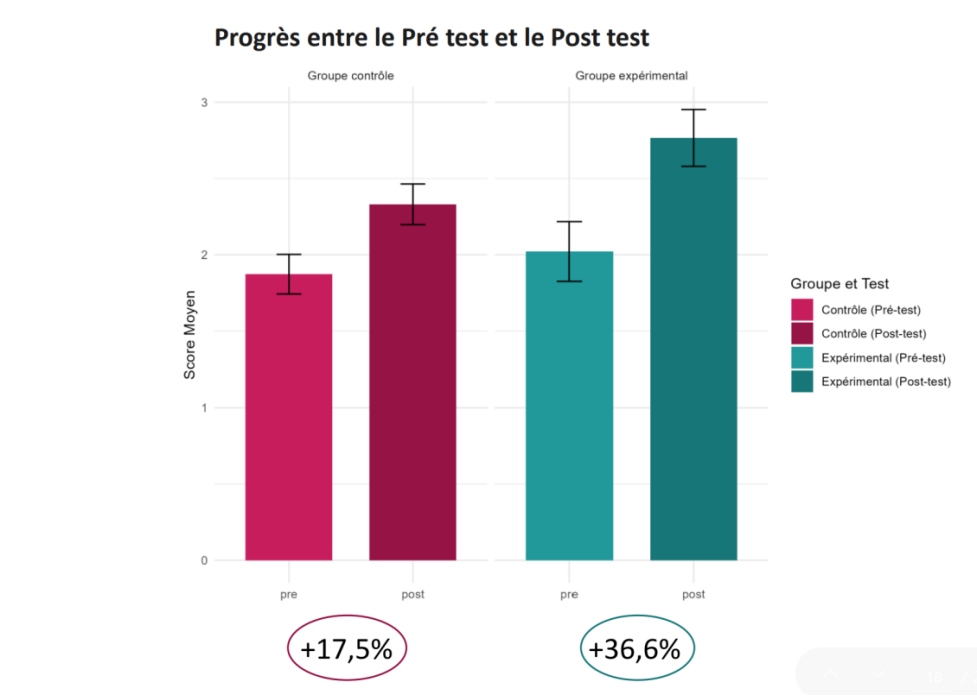
- Complete test (Bhatia et al., 2023):
o Control group: 0%
o EvidenceB Group: +7.9%
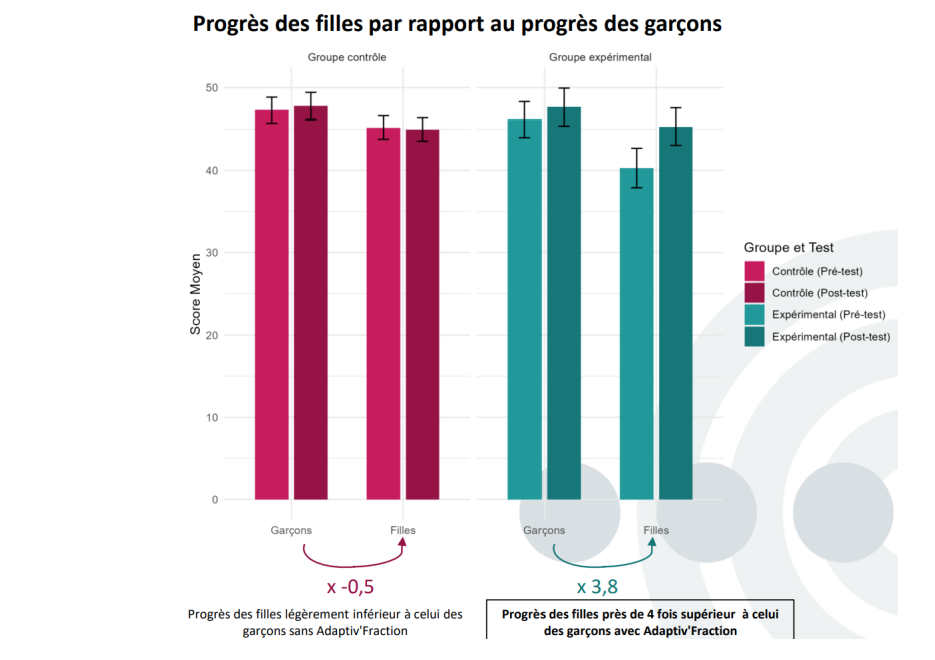 But most importantly , in the group using our resource, girls progress almost four times faster than boys.
A rare breakthrough in a discipline where they traditionally drop out as early as primary school.
An AI designed to boost confidence and prevent dropping out
Unlike generative AI, Adaptiv’Math+ does not produce automated content. It links on a personalization algorithm (called ZPDES – developed by the Inria-Flowers teams) to adjust the level of exercises in real time, stabilizing the success rate around 75% – the optimal threshold to maintain motivation and learning.
The solution was designed in collaboration with teachers and researchers in cognitive science, specifically to promote the understanding of complex concepts (fractions, proportionality) through visual representations, analogies, and a progressive approach.
According to André Knops, research director at the CNRS, Université Paris Cité, LaPsyDé: “ A sense of number and proportion are skills that are either innate or acquired very early in children. The challenge is to structure learning experiences that are rich enough for these skills to fully develop towards mastery of the corresponding mathematical concepts. ”
AI at the service of the professor
We advocate a humanistic and rigorous vision of artificial intelligence: a complementary tool, controlled by the teacher, which helps to detect the specific needs of each student and to structure differentiated learning paths.
“ We don’t believe in AI that replaces teachers, but in AI that helps teachers reinforce their students’ learning. By combining AI with cognitive science research, we can tailor the right exercise at the right time, restore confidence, and prevent students from dropping out, ” says Catherine de Vulpillières, GM-CIO and co-founder of EvidenceB
Access the study results here